
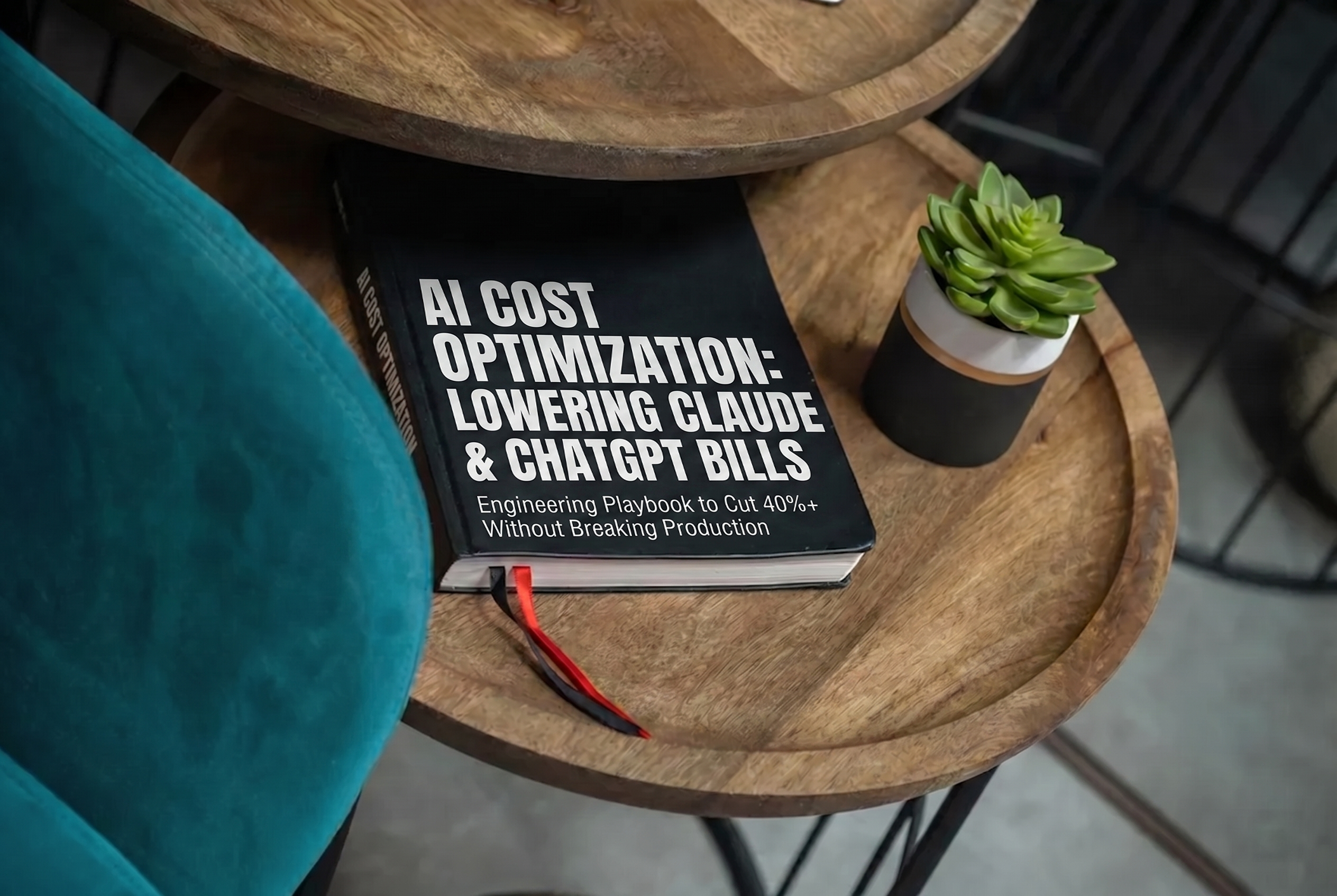
The initial AI hype phase was about getting features to work. Today, the reality is a massive “AI Hangover.” SaaS companies and platforms are scaling their user bases, only to find that their Anthropic or OpenAI API bills are entirely destroying their unit economics.
Cost reduction at scale is a serious engineering discipline. Over my career, I have specialized in massive infrastructure and software cost reductions—including architecting a lean automation platform for a travel company that saved $484,000 with a 4.4x ROI.
When you apply that same rigorous, enterprise-level engineering mindset to LLMs, you can easily cut your AI bills by 40% to 50%. Here is a practical guide on exactly how to do it.
1. Stop Paying for Overkill: Model and Vendor Choice
Many developers default to the biggest, most capable models (like Claude 3 Opus or OpenAI’s latest flagship flagship) for simple tasks. This is financially reckless.
- The Token Math: You don’t need to deeply understand neural networks to understand token economics. If you pay $1 for 1M tokens for Model A, and $2 for 1M tokens for Model B, the latter is twice as costly. Period.
- Benchmark This Tool: Never guess pricing. Use pricepertoken.com to instantly compare the cost per 1 million tokens across vendors.
- Match the Model to the Task (Pro Tip): Don’t use a specialized flagship like Claude Opus for basic summarization or JSON formatting. Run shadow tests to see if a mid-tier model like Claude Sonnet or Gemini Flash delivers identical results for a fraction of the price.
- Audit Your Agents: AI Agents are powerful, but they operate in loops. A single user request might trigger an agent to “think,” call a search tool, read the results, and think again—multiplying your token usage by 5x or 10x. If a well-crafted, single-shot prompt can do the job, do not use an agent.
2. The Token Diet: Managing the Context Window
LLMs charge you for every single word they read and write. If your application includes a chat interface, managing the context window is critical.
- Truncate History: If you send the entire conversation history back to the API with every new message, your token count grows exponentially. Only send the most recent, relevant context.
- Implement Prompt Caching: Anthropic and OpenAI now offer caching. If you are sending the same massive system prompt to the model thousands of times an hour, caching allows you to store that prompt and pay a fraction of the cost for subsequent calls.
3. Redesign the Pipeline (Case Study: 40% Cost Reduction)
Sometimes the highest costs come from how different tools interact with each other, rather than the AI model itself.
Recently, I designed and built a custom AI generation pipeline from scratch for a Finnish client, Helpotkotisivut. Working closely with their incredibly hands-on team, we had to experiment to find the most efficient architecture. The initial process required two distinct steps: generating the base content, and then relying on a secondary translator API for Finnish translation and quality control.
We carefully analyzed the architecture to see if this two-step process made economic sense at scale. By smartly omitting the middleware step and shifting to a highly capable native model (like Gemini, which excelled at Finnish in their specific case) to handle the localized workload directly, we bypassed the redundant loops. The result? Finnish output quality improved, and we jointly cut their generation bill by roughly 40%.
- Use the Batch API for a 50% Discount: OpenAI offers a Batch API for non-time-critical tasks. If you allow the system up to 24 hours to return the result, you get a flat 50% discount. Use it if you can!
Aligning AI with Your Business Model
Engineering fixes are only half the battle. Sometimes, the way you package and sell your AI features needs to change.
- Implement Smart Tiering: Limit flagship model access (e.g., OpenAI’s flagship) to your premium tiers or a set number of prompts per month. Use seamless fallbacks to efficient models (like OpenAI’s mini models or Claude Haiku) for non-premium users.
- Grandfather Older Models: When a vendor releases a new model, do not force all your existing users onto it automatically. Keep the general user base on the previous version, which is often discounted by the vendor, widening your profit margins.
Need to cut your Anthropic or OpenAI bill?
You can hand this playbook to your engineering team, and they will find savings. But if you have 10,000+ users, real money on the line, and want an expert to execute this quickly and safely, let’s talk.
Book a Discovery Call